Duplex Loads & Shot String

A5 Sweet 16

Well-known member
My opinion is that duplex loads (Boss really touts their 3/5 load) are dumb. Why the heck would I want part (1/2 by weight with Boss) of my load to lose steam 20 yds before the other pellets? I wouldn't. The larger pellets are for long range, at which point obtaining effective pattern density only becomes more challenging. The smaller pellets are basically ineffective, such that they don't do as claimed, which is make the shot pattern more dense. They're there. But they've lagged behind in a long shot string, & wouldn't penetrate a bird even if they hit it. I recommend using one shot size that will penetrate at the longest range you feel you can responsibly shoot a bird. That & appropriate choke promote effective pattern density.

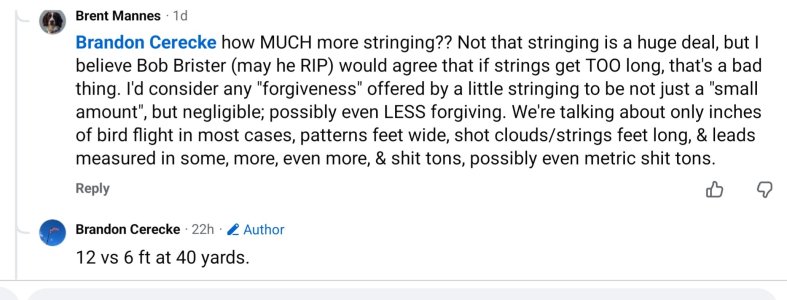
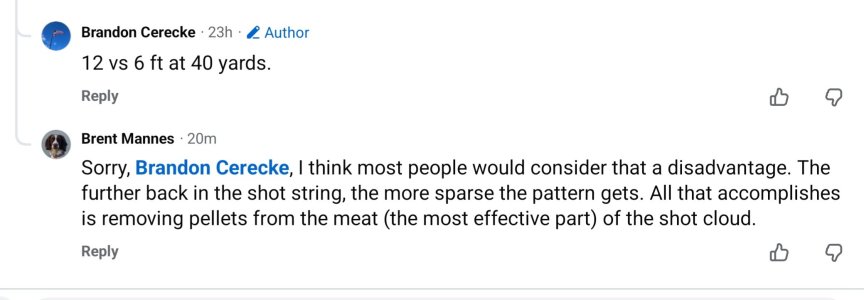
Brandon at Boss claimed on Facebook that longer shot strings caused by duplex loads offer a "small amount of forgiveness". No, Brandon. They don't.

Screenshot_20260322_223006_Facebook.jpg

Screenshot_20260322_223237_Facebook.jpg
 
Wow, I don't think I've ever agreed more with a post. I'm not claiming to be a ballistic savant, but when it comes to shotgunning I've put in my time reading literature. Perhaps it's due to self-doubt in shooting ability as well as lack of bird contacts. Fortunately my shooting has improved by and by as well as the places I have parked my truck in relation to rooster density. There's still a long way to go, but the enjoyment in the process and progress has been well worth it. In terms of shells/ballistics it comes to light that anything from 1 oz. plus will due in wingshooting wild birds. Yes less than this is possible, especially with tungsten, but that's its own special case and not to be discussed here*.

Shot string seems to be one of the most confused aspects of shotgunning. I've had people tell me that it's the cause of broken clays and dead birds when they clearly have no understanding of what it is or how it works. As a rule the more open the choke, the less the pellets draft behind each other and the longer the "string". Within the parameters of choke, from all that I have read, a shorter shot string is always better than a longer one. The pattern is what kills, and by this I mean the leading edge of the shot charge. An average hunting shell traveling 900mph will hit the bird traveling 30-40mph, the bird will under all but the most rare of chances not run into the tail end of the shotstring(buy a lottery ticket if he does).

I've heard hunters, boss employee/owners, and industry shills say things like, "our new 3/5 loads have reports coming in that they just hammer the birds!" Any target perfectly centered in range will be smashed regardless of the ballistic inferiority of said load. Boss isn't the only one. Hevi-Shots Hevi-hammer loads are comprised of 15% bismuth and 85% steel. They promise "More clean kills at longer distances. Improved cold weather performance." The only thing they materialize are more idiots spending more money to shoot shells that over-promise and under-deliver. If you have any hard evidence that duplex loads out-perform uniform shot charges I'm all ears, because like confirmed bigfoot sightings, they'd be the first ever seen.

A cylinder choke will always have a longer shot string than a full, and that's not a bad thing. Simply use the choke appropriate to the range at which you will shoot. Where it gets bad is comparing different loads from the same choke. A longer shot string from the same full or the same modified choke is a bad thing, unless you're a terrible shot and just hoping and praying to win the wingshooting lottery. In that case wish in one hand and $hit in the other and see what happens. Duplex loads are a complete joke and abomination, with shotshell manufacturers hoping to catch up the uninitiated in the latest and greatest in order to sell more product. I am glad that there are members of the shotgunning community at large willing to do what they can to bring mfgs. and their absurd claims to task. There will always be an attempt at new gimmicks, blended shot loads, ring of saturn pellets, "hypersonic" speeds, but as of yet they've all been proven worthless. It may not be sexy, but throw a load of round and hard pellets at your target through an appropriate choke for the range and after that it's all about how the shotgun is swung and pointed. There is no buying proficiency or "forgiveness" in a shotshell box, rather it is earned through experience and trigger time.

*tungsten shot is another kettle of fish. You'll find duplex loads there make sense, especially in larger bores. In these cases, the steel shot is nothing but filler for the shot column while the tss does all the work. All the smooth marketing talk about a steel/tungsten blend being the best of both worlds, never mentions that a large bore shot-column filled with all tungsten would be both heavy resulting in excessive recoil and expensive beyond the reach of the common waterfowler and upland hunter.

Postscript Bob Brister may not be the end all be all on shotgun ballistics, but from what I've read there's no other book that handles all things shotgun shooting related as well as his title Shotgunning: The Art and The Science copywrite 1976. A common question, "If you could hunt with anyone, who would it be?" My first choices would be my grandfathers, whom I never had a chance to walk the fields, the next would be Bob Brister. You read his books and get the feeling that he was just a great dude who loved shotgun shooting and hunting more than anything. My next choice? How could a guy ever pass up a chance to hunt with Golden Hour and his labs? How they manage so often to bag a limit of birds around Watertown is beyond me. A chance to witness the hunting of those spectral roosters on the shores of Lake Kampeska is something on terms with once in a lifetime.20260323_012918.jpg
 
Long shot strings are very advantages because if there are multiple birds flying in a line you can miss the 1st one and hit the 2nd and maybe the 3rd! You can also whip the gun barrel around in a circle while firing from the hip and fill the entire area with shot therefore increasing your chances of hitting something. ;) You won't believe this, but my brother hunted with a guy who said just that!! Sawed off his barrel and shot at quail like that. Weirdly, they became good friends. My brother taught him to shoot but he was never very good.
 
The last couple of paragraphs in this article discuss shot string (and mention Bob Brister).


When that was first published, there was a video. The video clearly showed that the trailing pellets in a shot string strike a pattern board at the outer edges of the pattern. To me, the lesson is that the trailing pellets (outer fringe) of the shot pattern have less energy than than the core pellets. These pellets are more likely to wound a bird than the higher energy pellets forming the core of a pattern.
 
I know next to nothing about the topic but……

I do know that if you mix particle sizes up in a container you get less pore space.

Take an extreme: a full cup of BB shot will take on plenty more #8 shot, filling the voids left between the larger shot.

Interesting point: a cup full of BBs will have the same void space as a cup of #8 shot. That of course is unrelated to this.

Source : soils class from when the glaciers were retreating.
 
The OP is correct about same material duplex loads, no real value IMHO.
The big advantage of tss/ steel duplexes is in the sub gauges, 28,410 maybe 20 ga.
#9 tss is ballistically equal to b’s in steel, There is 360 pellets in an oz of tss #9.
I load 1/4oz of tss #9 with #2,or #3 steel in my 28 ga. Makes a great pheasant load, waterfowl load. Plenty of pellet count, with very similar ballistics.
 
I am glad that someone else recognizes that same metal duplex loads were either created by someone who doesn't understand ballistics or as a marketing ploy. A shotgun load fails when the pattern density becomes to thin or from a lack of pellet energy. A duplex load is going to have one of those two metrics fail at a shorter distance than a single shot size. Companies have figured out how to market decreased performance as a benefit.

I do not have experience or well formed thoughts on mixed metal loads, but I can kind of see the logic of using steel in front of TSS to open otherwise tight patterns.
 
I've heard hunters, boss employee/owners, and industry shills say things like, "our new 3/5 loads have reports coming in that they just hammer the birds!" Any target perfectly centered in range will be smashed regardless of the ballistic inferiority of said load. Boss isn't the only one. Hevi-Shots Hevi-hammer loads are comprised of 15% bismuth and 85% steel. They promise "More clean kills at longer distances. Improved cold weather performance." The only thing they materialize are more idiots spending more money to shoot shells that over-promise and under-deliver. If you have any hard evidence that duplex loads out-perform uniform shot charges I'm all ears, because like confirmed bigfoot sightings, they'd be the first ever seen.
This reminds me of a quote from a John Wayne movie, True Grit where Ned Pepper says "I call that pretty bold talk from a one eyed fat man"
I must be one of those idiots that you refer to in your statement! I bought those 20 gauge Hevi-Hammer Upland loads for my wife to shoot in South Dakota so she only had to have one load to carry in her vest after she accidentally carried some lead in to a non tox field. She has always been a decent shot but she's deadly with those Hevi-Hammer loads of #3 steel and Bismuth from her Franchi O/U with IC/M chokes. Granted this is not a significant data set with only one participant but they also worked well for me on decoying ducks from a blind.
I was gifted a box of the Migra 20 ga 4/6 shot that seemed to work well on roosters. Are they any better than my standard loads of 1 ounce of 6's, I'm not sure because I haven't shot enough of them to really form a strong opinion one way or the other.

Since you called me an idiot already I guess that gives me the right to ask you if you have ever tried either the Boss or Hevi-Hammer loads that you seem to despise with your vast years of experience as a shotgunner! From your long post it doesn't appear that you have.

I've been shooting a shotgun for 55 years. I shot trap competitively for about 10 of those years and have killed a bunch of roosters, quail, ducks and geese as well but by my own admission I'm no expert. There are things about shotgunning that I don't understand and don't pretend to. I have opinions on many things but if those Boss or Hevi-Hammer shells are working for shotgunners who are you to call them idiots for spending THEIR money on something that works for them?
 
I bot some hevi metal 12 gauge #3 loads many years ago…combo of steel and ???…think it was hevi shot, could be Bismuth…still use them here and there on ground requiring non-tox, which I hunt on a bit…most of my public land allows toxic…anyway, that hevi metal has been very effective, much more than 100% steel. Think it was about $1-1.25/shell…would keep buying it if I needed non tox….I’m probably 2-3 boxes into
this ammo…
 
Last edited:
Duplex loads are much misunderstood. Their real value began with steel shot. With high velocity steel...they have a use. You can put 10-15% of the load on top with heavier pellets and it will keep your patten tighter. That is to say...if you've got a "hot" steel load that's moving at well above 1500 fps. Lets say a 1.0 oz of steel 3's you can put 10-15 (by weight) of steel BB's on top and it will keep your pattern tight...given the right choke tube. I loaded a 1.0 oz steel 3 load for years that was an absolute killer in this configuration. Carlson choke...0.705 constriction out of my Beretta. Still shoot it to this day on ducks over decoys. Lower velocity steel isn't an issue. When steel was first mandated...I use an old MEC load using 800X powder, CCI 209M primer pushing 1 1/8 oz of steel in a Fed GM hull that was pure poison. But it was only at about 1400 fps max...you don't need to duplex. Today...duplex loads are more of a marketing issue. Making you think your getting something for nothing. They can put a 1/16 oz of "hevi" shot...what ever that shot might be...on top of ordinary steel and a lot of guys will buy it. In the end...they're just shooting steel.
 
Duplex loads are much misunderstood. Their real value began with steel shot. With high velocity steel...they have a use. You can put 10-15% of the load on top with heavier pellets and it will keep your patten tighter. That is to say...if you've got a "hot" steel load that's moving at well above 1500 fps. Lets say a 1.0 oz of steel 3's you can put 10-15 (by weight) of steel BB's on top and it will keep your pattern tight...given the right choke tube. I loaded a 1.0 oz steel 3 load for years that was an absolute killer in this configuration. Carlson choke...0.705 constriction out of my Beretta. Still shoot it to this day on ducks over decoys. Lower velocity steel isn't an issue. When steel was first mandated...I use an old MEC load using 800X powder, CCI 209M primer pushing 1 1/8 oz of steel in a Fed GM hull that was pure poison. But it was only at about 1400 fps max...you don't need to duplex. Today...duplex loads are more of a marketing issue. Making you think your getting something for nothing. They can put a 1/16 oz of "hevi" shot...what ever that shot might be...on top of ordinary steel and a lot of guys will buy it. In the end...they're just shooting steel.
I don’t think I’m getting something for nothing, the hevi metal shells I’ve bot are more expensive than straight steel…you know a lot more about shotgun shells than me, but I’ve shot lots of roosters with #3 steel, and I’ve lost lots of them…my results with the hevi metal are markedly better, but I’ll acknowledge that shooting a few dozen with those loads isn’t enough to prove anything…but based on my experience, I grab those shells first when I need 12 gauge non tox…and I’d keep buying them at a higher price vs steel when I need more 12 gauge non tox…
 
I don’t think I’m getting something for nothing, the hevi metal shells I’ve bot are more expensive than straight steel…you know a lot more about shotgun shells than me, but I’ve shot lots of roosters with #3 steel, and I’ve lost lots of them…my results with the hevi metal are markedly better, but I’ll acknowledge that shooting a few dozen with those loads isn’t enough to prove anything…but based on my experience, I grab those shells first when I need 12 gauge non tox…and I’d keep buying them at a higher price vs steel when I need more 12 gauge non tox…
The old "Hevi Metal" with hevi-shot were very good shells. The new ones with bismuth...I've not used them. For "diluted" shotshells...the old ones with hevi-shot were worth the money with the hevi-shot. They killed. I used then and had results better than I expected. But bismuth on steel?...sounds like a way to crush pellets that are already delicate. All my bismuth loads are all bismuth and buffered. Period.
 
Last edited:
Back
Top