Wow, I don't think I've ever agreed more with a post. I'm not claiming to be a ballistic savant, but when it comes to shotgunning I've put in my time reading literature. Perhaps it's due to self-doubt in shooting ability as well as lack of bird contacts. Fortunately my shooting has improved by and by as well as the places I have parked my truck in relation to rooster density. There's still a long way to go, but the enjoyment in the process and progress has been well worth it. In terms of shells/ballistics it comes to light that anything from 1 oz. plus will due in wingshooting wild birds. Yes less than this is possible, especially with tungsten, but that's its own special case and not to be discussed here*.
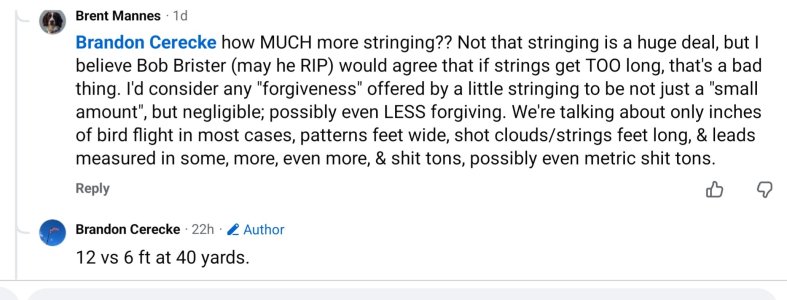
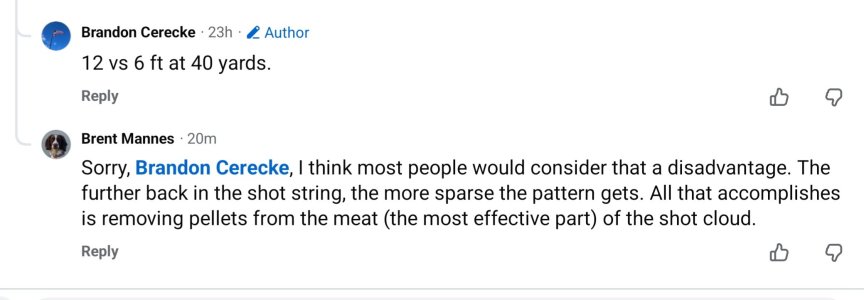
Shot string seems to be one of the most confused aspects of shotgunning. I've had people tell me that it's the cause of broken clays and dead birds when they clearly have no understanding of what it is or how it works. As a rule the more open the choke, the less the pellets draft behind each other and the longer the "string". Within the parameters of choke, from all that I have read, a shorter shot string is always better than a longer one. The pattern is what kills, and by this I mean the leading edge of the shot charge. An average hunting shell traveling 900mph will hit the bird traveling 30-40mph, the bird will under all but the most rare of chances not run into the tail end of the shotstring(buy a lottery ticket if he does).
I've heard hunters, boss employee/owners, and industry shills say things like, "our new 3/5 loads have reports coming in that they just hammer the birds!" Any target perfectly centered in range will be smashed regardless of the ballistic inferiority of said load. Boss isn't the only one. Hevi-Shots Hevi-hammer loads are comprised of 15% bismuth and 85% steel. They promise "More clean kills at longer distances. Improved cold weather performance." The only thing they materialize are more idiots spending more money to shoot shells that over-promise and under-deliver. If you have any hard evidence that duplex loads out-perform uniform shot charges I'm all ears, because like confirmed bigfoot sightings, they'd be the first ever seen.
A cylinder choke will always have a longer shot string than a full, and that's not a bad thing. Simply use the choke appropriate to the range at which you will shoot. Where it gets bad is comparing different loads from the same choke. A longer shot string from the same full or the same modified choke is a bad thing, unless you're a terrible shot and just hoping and praying to win the wingshooting lottery. In that case wish in one hand and $hit in the other and see what happens. Duplex loads are a complete joke and abomination, with shotshell manufacturers hoping to catch up the uninitiated in the latest and greatest in order to sell more product. I am glad that there are members of the shotgunning community at large willing to do what they can to bring mfgs. and their absurd claims to task. There will always be an attempt at new gimmicks, blended shot loads, ring of saturn pellets, "hypersonic" speeds, but as of yet they've all been proven worthless. It may not be sexy, but throw a load of round and hard pellets at your target through an appropriate choke for the range and after that it's all about how the shotgun is swung and pointed. There is no buying proficiency or "forgiveness" in a shotshell box, rather it is earned through experience and trigger time.
*tungsten shot is another kettle of fish. You'll find duplex loads there make sense, especially in larger bores. In these cases, the steel shot is nothing but filler for the shot column while the tss does all the work. All the smooth marketing talk about a steel/tungsten blend being the best of both worlds, never mentions that a large bore shot-column filled with all tungsten would be both heavy resulting in excessive recoil and expensive beyond the reach of the common waterfowler and upland hunter.
Postscript Bob Brister may not be the end all be all on shotgun ballistics, but from what I've read there's no other book that handles all things shotgun shooting related as well as his title
Shotgunning: The Art and The Science copywrite 1976. A common question, "If you could hunt with anyone, who would it be?" My first choices would be my grandfathers, whom I never had a chance to walk the fields, the next would be Bob Brister. You read his books and get the feeling that he was just a great dude who loved shotgun shooting and hunting more than anything. My next choice? How could a guy ever pass up a chance to hunt with Golden Hour and his labs? How they manage so often to bag a limit of birds around Watertown is beyond me. A chance to witness the hunting of those spectral roosters on the shores of Lake Kampeska is something on terms with once in a lifetime.




 You won't believe this, but my brother hunted with a guy who said just that!! Sawed off his barrel and shot at quail like that. Weirdly, they became good friends. My brother taught him to shoot but he was never very good.