Paging Member birddude

Bob Peters

Well-known member
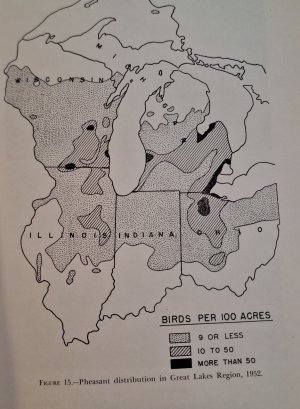
I'm reading a book called Pheasants in North America(author last name Allen), and have to admit I thought of you. To couch my sentiment, first I'll say I'm not making light of the fate of pheasants in the modern world with all the habitat loss etc. That out of the way, reading about the "Lake States" Wisconsin, Michigan, Illinois, Indiana, and Ohio, it does appear that Indiana, even in the good old days, was always the weak sister in terms of wild bird populations. That's all I got.
 
Well, I wouldn't say always. My granddad fed 9 kids on mostly quail when in season. Up until the 90's I commonly shot 100 birds a year. Granted I hunted a lot. I've never sat down and counted but can recall 5 or 6 coveys a day was common, double digits were rare but did happen. I realize that someone from the west might scoff at those numbers, but it was wonderful compared to today. I also put a setter pup in coveys 50 times before season in mainly the one township in the mid 80's. Keep in mind that southern Indiana is a world apart from the north.
 
The theory that always made the best scents to me is that pheasants can only reproduce in areas where there were thousands of years of prairie grass. Leaving some compound in the soil that they need to fully form the eggshells. There is a few thousand acers 50 miles north of me that the old timer used to say they made it but people and predators got them.
 
The theory that always made the best scents to me is that pheasants can only reproduce in areas where there were thousands of years of prairie grass. Leaving some compound in the soil that they need to fully form the eggshells. There is a few thousand acers 50 miles north of me that the old timer used to say they made it but people and predators got them.
I haven't heard the prairie grass theory. But here's something and it might be closely related.

Wild pheasants in North America are found only in places that have high soil fertility. So in essence, anywhere there is successful agriculture there will be pheasants. It seems to be born out across the country in historical pheasant records. Their strongholds in the northeast were a portion of NJ and the Lancaster Valley in PA where farming was excellent. In New York the highest populations were in the Ontario Lowland. In the west and southwest it was really fascinating that anywhere there was irrigation pheasants tended to flourish. The Sacramento Valley rice belt in CA, eastern Slope of Colorado, Weber river valley in Utah. Anywhere with fertile soil and water the birds have a chance. It seems the one corner of the country birds could never make it is the SE. You reach a point where average nesting air/soil temp and humidity is too high and egg fertility and nest success cannot overcome annual pheasant mortality.

The book I read is "Pheasants in North America" by Durward Allen, although many biologists worked on it from different regions of the country. Most of the data is from the 40s and 50s but still of interest to those wanting to know more about the birds history.
 
Back
Top